The ultimate guide to protein shakes
But… not all shakes are created equal.
With so many shakes now available on the market – each pumped full of marketing hype and new ‘superfoods’, it’s hard to find a shake that’s actually good for you.
In this blog, we’ll highlight the key things you should look for in a protein shake, along with ingredients we love and those you should definitely avoid.
How to choose a good protein shake
When it comes to protein shakes, it's important to be mindful of the ingredients you're putting into your body. Before getting swept away by marketing buzz words, the best way to determine the quality of a protein shake is to look at the nutritional information panel, the ingredients list and the allergen warnings.

A nutritional information panel (NIP) is a table of standardised data that helps consumers make informed decisions about the food they eat. Australian food regulations require ALL packaged foods to display a NIP that lists the protein, carbohydrate, fats, sugar, dietary fibre and sodium/salt content.
The list of ingredients needs to be displayed by weight – greatest to smallest. This information listing is also helpful in determining the quality of your protein shake, along with the allergen warnings. Of course, if your protein shake displays any certifications from authoritative industry associations – this definitely adds credibility.
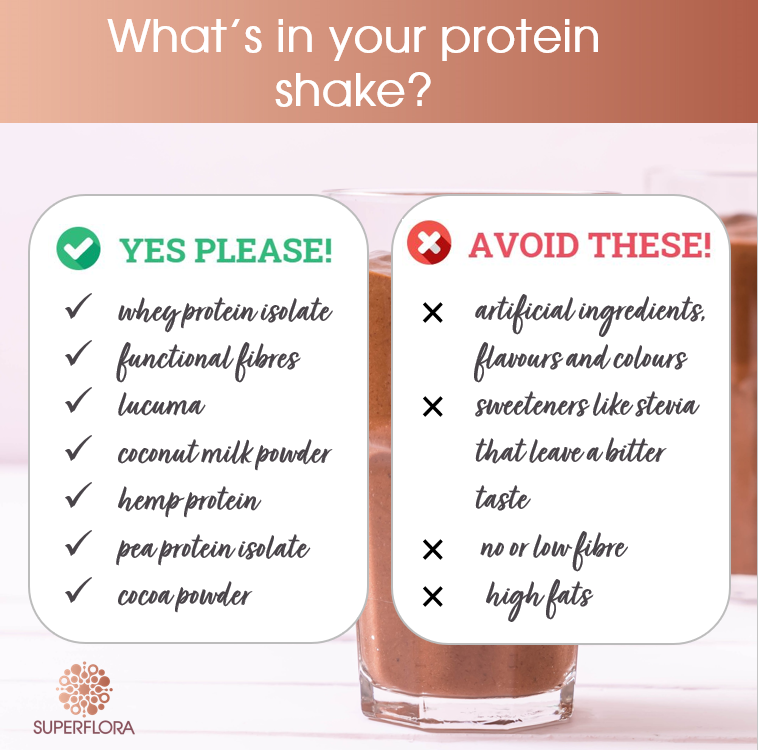
What’s in your protein shake?
Here are 6 things to look out for when purchasing a protein shake. If you’ve already got some product in your pantry, why not grab it now so you can use this checklist to see if it passes the test!
1. Does it contain a good source of protein?
You'll want to make sure that the protein shake you choose contains enough protein to meet your needs – at least 20-25 grams per serve. Quantity matters, but so does quality. What is the main protein source in the shake – whey, pea, brown rice, fava beans?
Because you’re buying a protein shake, the main protein source should be the first ingredient listed. If the protein source makes up 50%+ of all ingredients, where it comes from might be important to you to, so check the country of origin labelling. If you have any gut health issues, make sure the protein source is certified fodmap friendly so it doesn’t cause any tummy upsets.
2. Prioritise natural ingredients
Do you recognise all of the ingredients listed? Or does the list contain numbers or generic words like ‘sweeteners’ but no other detail as to what that actually means? Common additives that are listed as numbers in protein ingredients are soy lecithin (322), potassium lactate (326) and sorbitol (420).
Many protein shakes on the market contain artificial sweeteners, flavours, and colours, which can be harmful to your health. If you don’t recognise all of the ingredients listed, Google is your friend. Ensure you know what’s in your food!
3. How many calories per serve?
Check out the total number of calories per serving size. If you’re buying a protein or meal replacement shake in Australia, you should see these broken down by serving size and per 100g so you can easily compare between products.
Is the total number of calories too high or too low for your energy needs?
4. Is your shake full of fat?
There are different types of fats – so make sure you look at the total fat content, as well as saturated fats - linked to increased risk of heart disease and high blood cholesterol. Does your shake have less than 10g per 100g of total fat?
5. How is your shake sweetened?
All shakes contain sweeteners to make them more palatable but quantity and quality matters. It’s not necessary to avoid ALL sugar but try to avoid amounts that will cause spikes and crashes (around 4 grams per serve).
If sugar is listed in the first few ingredients of your shake, it’s likely to be more than 15g per 100g and should be avoided.
Be on the lookout for sugar in disguise aka dextrose, fructose, glucose, sucrose, maltose, sucralose and aspartame. Artificial sweeteners such as stevia and monk fruit can leave a bitter and metallic aftertaste.
6. How much fibre?
Some protein shakes can make you feel constipated because they don’t contain enough fibre. Fibre can help to keep you full longer and can also help to improve your gut health. Aim for 7 grams per serve.
There are no requirements under the Food Standards Code to identify the type of fibre contained in a protein shake – whether it’s soluble or insoluble, fermentable or viscous. If you’re worried about how the fibre might impact your digestive system, look for fodmap friendly certification or talk to your dietitian.
Ingredients we avoid
Sucralose (E955)
Sucralose is a no-calorie, non-nutritive sweetener derived from sugar and contains chlorine. It is intensely sweet, about 300-1000 times sweeter than sugar.
According to Australian Food Standards, sucralose is made by replacing three hydrogen-oxygen groups on a sugar molecule with three chlorine groups. An average daily intake of 0-15mg/kg body weight per day has been established based in animal studies.
There are a growing number of studies that demonstrate the negative impact of sucralose on good gut bacteria.
Steviol glycosides (960)
Steviol glycosides are an intense sweetener extracted from the leaves of the stevia plant (Stevia rebaudiana Bertoni). Steviol glycosides are around 150 to 300 times sweeter than sugar. The Australian Food Standards Code allows steviol glycosiders to be added to certain foods as a food additive with an acceptable daily intake of 0-4 mg/kg per body weight.
According to new research, stevia may not be responsible for killing off good gut bacteria but may disrupt communications between different bacteria in the gut – unbalancing the microbiome.Read this study to find out how saccharin, sucralose and stevia change the composition of gut microbiota. Plus, the roots of the stevia plant contain inulin and fructans which can trigger gut health symptoms in people with Irritable Bowel Syndrome.
Xylotiol (E967)
Xylotiol is a naturally occurring sugar alcohol. The Australian Food Standard Code does not set a limit on its daily intake. However, due to the laxative effect of polyols, xylotiol is banned from soft drinks in the European Union.
Moderate doses of polyols can adversely impact the gut microbiome in healthy people and can trigger hut health symptoms in people with Irritable Bowel Syndrome.
Artificial colours, flavours and additives
We get it! It’s hard to avoid food additives. And the scientific literature about their effects can be contradictory, depending on who has paid for the study.
According to the Australian Food Standards Guidelines, most food additives should be listed on the product label, along with other ingredients, in a descending order by weight (flavours are an exception and do not need to be identified). If the additive is not named, it might be listed by the specific internationally recognised code number.
Avoid products with artificial food colourings 102, 104, 110, 122, 124 or 129 on their ingredient list. Other additives might be described as emulsifiers (stops fats from clotting together), food acids (maintain acidity levels), flavour enhancers, foaming agents, mineral salts (enhance texture and flavour), preservatives (increase shelf life), thickeners and vegetable gums (enhance texture) and bulking agents.
Ingredients we love
Whey protein isolate
Whey protein isolate is made from fresh cow’s milk using an innovative filtration process that results in a high protein, low carbohydrate and low fat powder. Its low lactose content is generally well tolerated by those with gut health issues and dairy sensitivities.
Australian whey protein isolate is 99% sugar and fat free. It is rich in the amino acid leucine, valued for its role in muscle protein recovery. It’s also a rich source of other functional whey proteins including α-lactalbumin, β-lactalbumin and Immunoglobulins.
Because whey protein isolate is rapidly digested and absorbed, its great for protein shakes. But be careful – whey protein isolate and whey protein concentrate are NOT the same. Whey protein concentrate is now low fodmap and may trigger tummy upsets in some people. Whey protein isolate, however, contains little or no lactose which is more suitable for those with lactose intolerance or those avoiding fodmaps

Lucuma (pronounced
loo-too-ma)
Lucuma powder comes from the fruit of a native South American tree. Its creamy butterscotch flavour makes it a great natural low GI sweetener, safe for diabetics and others wanting to avoid blood sugar spikes.
Lucuma has the same amount of calcium as a glass of cow’s milk, along with zinc, iron, Vitamin C, niacin and fibre. Its rich antioxidants including carotenoids and polyphenols help to fight and prevent disease.
Lucuma’s texture is comparable to granulated sugar, but it has 75% less sugar than table sugar.

Comments
Post a Comment